
Second chapter in the saga: the return to racing of Coach D aka Tales of the Third Age. After three years, he finally finds the courage and, above all, the recklessness to set off again for his favourite distance, the revered hundred miles. Why? How did it go? Let’s hear it from his narration.
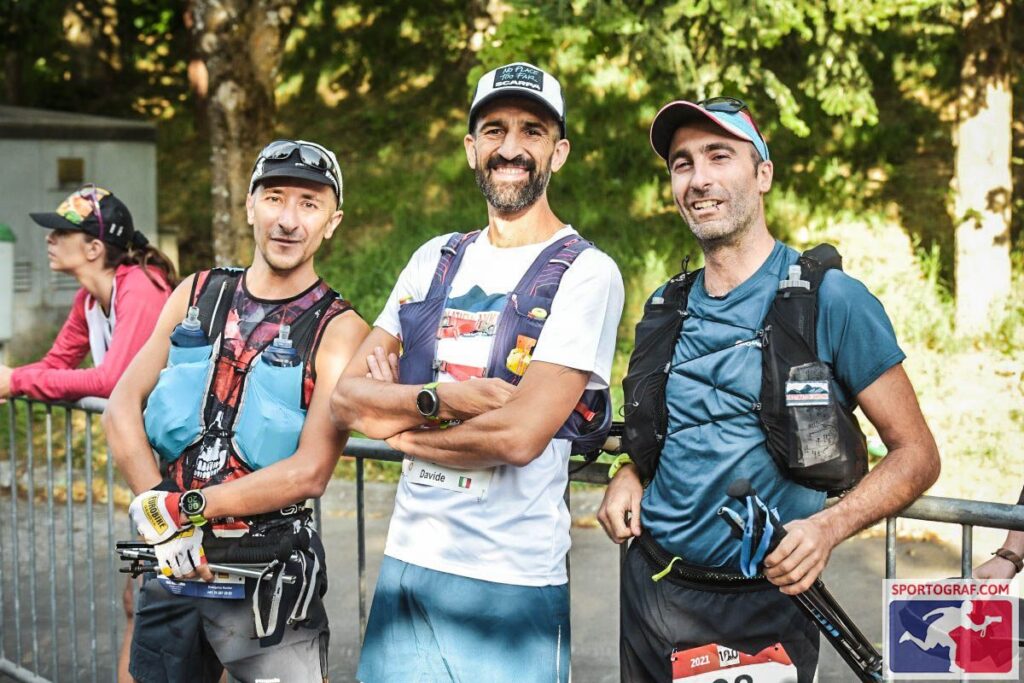
Approach: After the Swiss Alps 100 in 2021, I no longer had the desire or the consistency to put myself down and really prepare for a hundred miler. Too much had happened since that August to resume the usual routine: race, training, more racing, more training, new race. In fact, the routine had already been broken in 2020 with the COVID: Swiss Alps had been my attempt to return to certain demands, to manage to force racing into the same role it had had pre-COVID, and if from a practical point of view it had worked, mentally and emotionally it had been difficult. So much so that for a thousand reasons, and without getting around it also because it had been the last time Paco and I had shared a weekend, it had remained almost ‘in the way’, a heavy box to move and difficult to tidy up. The development of DU, the changes in my and Mari’s life with the move to the mountains, time passing… I had to rearrange racing in my life. Give it a new value. Once that was done, then I could also go back to Fiesch and Swiss Alps. In my head it was logical to start there again. To rebuild and put in place a few memories that were still in disarray, to give them the value they deserve, like when you put the frame on a nice photo or a nice drawing.
Approach
How to handle the approach to Swiss Alps? I knew I had to change something. I had always prepared for races in the same way, to the point of maniacally repeating the same five or six workouts year after year: I knew they were the most effective, I didn’t ask myself any other questions. Priority to volume, quality twice a week, hyperspecificity and blocks as long as six months. Simple and functional. But as time passes, new variables arrive, and if in 2021 I had pretended not to see them, and somehow managed to get by, now they had to be addressed. After a catastrophic December due to relocation, from January I set out with a different idea: to devote three months to developing a solid aerobic base, even occasionally inserting other disciplines (skimo or bike) and only then to move on to the usual specific part with Aerobic Power/ Threshold/Tempo/Endurance. Even at the expense of losing quality training, I wanted to maximise and stabilise a solid base on which I could then graft the rest in less invasive doses (ah, aging). It was also a way to allow me to put the real focus on the race later, as I was starting to suffer from too long blocks. For the first time, I was also determined to periodise the strength work in a very specific way by combining the Aerobic Power block (high intensity/low volumes) with the development of Maximum Strength (high overload/low repetitions/long recovery) and only then, in the Threshold and Tempo phase, move on to the classic Endurance Strength (medium overload/medium repetitions) and close with a final phase where, together with the higher volumes, I would do Conditioning-only work on my ‘weaknesses’. Also because the access to a terrain with the possibility of doing vertical meant doing continuous strength work in the last phase anyway. Finally, the subject of nutrition and supplementation also had to be addressed. After years of ‘justgels’ the last few races (Swiss Alps included) had forced me to deal with the problem of nausea and vomiting. Time for a change.
Tech & Data
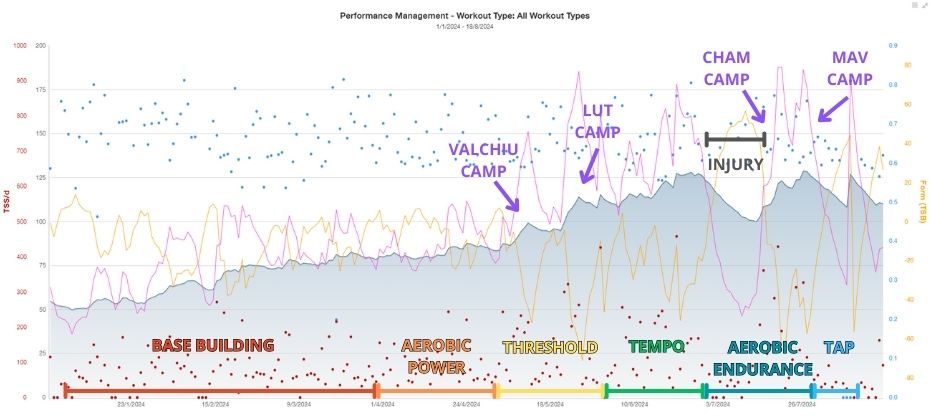
Things went well right from the start. January and February with decent volume, a lot of muscular work done often uphill but without heavy cardiovascular impact, a few steady/moderate to increase the ability to stay in that blessed zone 2 high and easy long runs. A varied strength session and for a few weeks also an attempt to include a weekly plyometrics session (an attempt which was then wrecked in March when the work became significantly more important in terms of volume). Until the end of March I kept almost a day a week on skis (often lift assisted since a few big dumps came in) and an occasional evening bike ride with Janpo (yes, in winter, that’s how we are, we don’t like simple things), which served more to relax and not obsess over running. In these three months it was crucial to have my beloved treadmill back: all the tempo/threshold work was done there as well as some steady uphill or progression blocks always just above the Aerobic Threshold or first threshold (very useful).
Aerobic Base Construction Phase (12 weeks)
weekly activity hours (including S&C and XCrosstraining) h 10:40
average running distance x week 70 km
average running distance x week 2000 m/dsl
Arriving in April, I started with high intensity, what we call Aerobic Power. A big weekly workout (more in terms of intensity than volume), a big strength workout (3-4 sets of 3-5 reps divided over six basic squat/hinge/push/pull/brace/calf exercises) and often some hard stimulus in the long run (never excessive). It worked, and well too: I felt responsive despite the loads and the results came out, even if a bit of peak performance was missing (ah, age, again). The distribution of the time spent in the different zones showed a clear decrease in zone 2 and a fair increase in zones 3 and 4. Nevertheless, with such continuity, the volume went up, even if this was not necessarily reflected in a dramatic increase in CTL: a point to be considered.
Aerobic Power Phase (4 weeks):
activity hours per week (including S&C and XCrosstraining) h 13:47
average running distance x week 97 km
average running distance x week 2600 m/dsl
May, in my intentions, was the month in which I was to work the full threshold, a phase that is by no means congenial to me, but which the Venerable Renato considers indispensable for titillating the enzymes that aid the disposal and transformation of lactate. Looking back, something was done, both in the form of Interval Training and with continuous blocks of 20/30 minutes… but the fact is that during this month I’ve thrown in two camps (not on the athlete’s side obviously but on the coach’s side) which have taken the mileage through the roof, but removed the possibility of doing quality work and left a certain feeling of overcooking. Too much mileage, too early, and it is clear from the data, even if at CTL level the surge was substantial and in any case ‘digested’ once the state of fatigue returned to normal.
Threshold Phase (4 weeks):
weekly activity hours (including S&C and XCrosstraining) h 19:44
average running distance x week 116 km
average running distance x week 5100 m/dsl
June is Lavaredo time. And so, lots of stress for DU. But despite this, the month started well with URMA 50k, done decently, without killing myself, but with the right intensity. Despite the previous monstre week of 100 miles, and a certain general lack of verve, the ability to stay in dangerous areas was still there and I returned home happy and ready to attack the Tempo phase before hitting Recovery Week in Cortina, where I already knew I would run little, sleep badly and so on. Here I also started to put in some heavy work in long climbs of 1000/1200 metres divided into intense blocks, combined with repeats over 2/3 k that I almost always do on the treadmill. In the gym, since May, I kept the six exercises of the Maximum Strength phase, transforming them into Strength Endurance work and some additional mobility/dynamic stretching routines because I was starting to feel some soreness, which I carelessly attribute to the marked increase in volume given by the long runs, that became 5/6 hour outings. Before the Recovery Week in Cortina I did three days of Bikepacking, a recall of Vo2Max and then a back-to-back-to-back of those 1000/1200 metre uphill works to keep my mind at ease before starting the last specific block of Endurance.
Tempo Phase (5 weeks)
activity hours per week (incl. S&C and XCrosstraining) h 18:20
average running distance x week 97 km
average running distance x week 3900 m/dsl
June: the shit hits the fan. I woke up on Tuesday morning post LUT, and couldn’t get out of bed: my left knee, which had been a bit sore for the past few weeks, was completely locked up. Initial panic, classic reasoning ‘one day of rest is enough’, but during the day the pain increased in the medial part. I’m not a doctor but the idea was that the meniscus was suffering. Chicco, my physio as well as former athlete, tells me that without an MRI it is difficult to understand, but that the meniscus is probably not broken: it is most probably the cartilage that after so many years of service and mileage is becoming to be a bit spent. I know it sounds absurd, but it’s the first real injury I’ve had to deal with in twenty years. The race is sidelined, I start studying the options I’m being given for the future (hyaluronic acid, PRP and so on), but what I need now is to try to stay on my feet for the Chamonix Camps I have in a two weeks’ time. TESLA shock therapy + Voltadvance to relieve inflammation (when it is needed, it is needed, sorry). Four days at a standstill, a week of jogging, then I try a few timid uphill sprints and a two and a half hours of long run: with the Fisio’s approval, I go to Chamonix for Camp. Monday, three hours and everything holds up. Tuesday big day in reconnaissance with Tommy, Fra and two of my foreign athletes, Torben and Max. Everything seems to be OK. In short, with a lot of attention and mobility twice a day, the week of Camp DU flies by with 160 km and 9200 metres of altitude difference, the week after with Camp Maverick ends with 120 km and 4500 metres of altitude difference: do you want me not to try and do the race as well? In these four weeks, for obvious reasons, no strength work, but mobility and dynamic stretching almost every day. Very, very cautious tapering ( definitely too much, but I wanted to get to the startline healthy) and here we go, Swiss Alps here we come.
Aerobic Endurance Phase (4 weeks)
weekly activity hours (including S&C and XCrosstraining) h 16:14
average running distance x week 92 km
average running distance x week 4200 m/dsl
Tapering Phase (2 weeks)
activity hours per week (incl. S&C and XCrosstraining) h 05:10
average running distance x week 45 km
average height difference running x week 750 m/dsl
Race Day
Race Day I was happy, content and even a little excited. So much so that I realised in Fiesch that I had left my watch at home. But having solved the problem thanks to Rino and Andrea (thanks guys), there was really nothing that could stop me from enjoying myself. Especially if my knee left me in peace.
The experience of 2021 had taught me that I had to start very relaxed. Also because this year I had only one goal: to finish. I really went into the race with no other expectations, I just wanted to run well, play the race well and get to the end. If I did what I knew, I was sure to run efficiently anyway. Maybe not as performant as I used to be, but efficient yes!
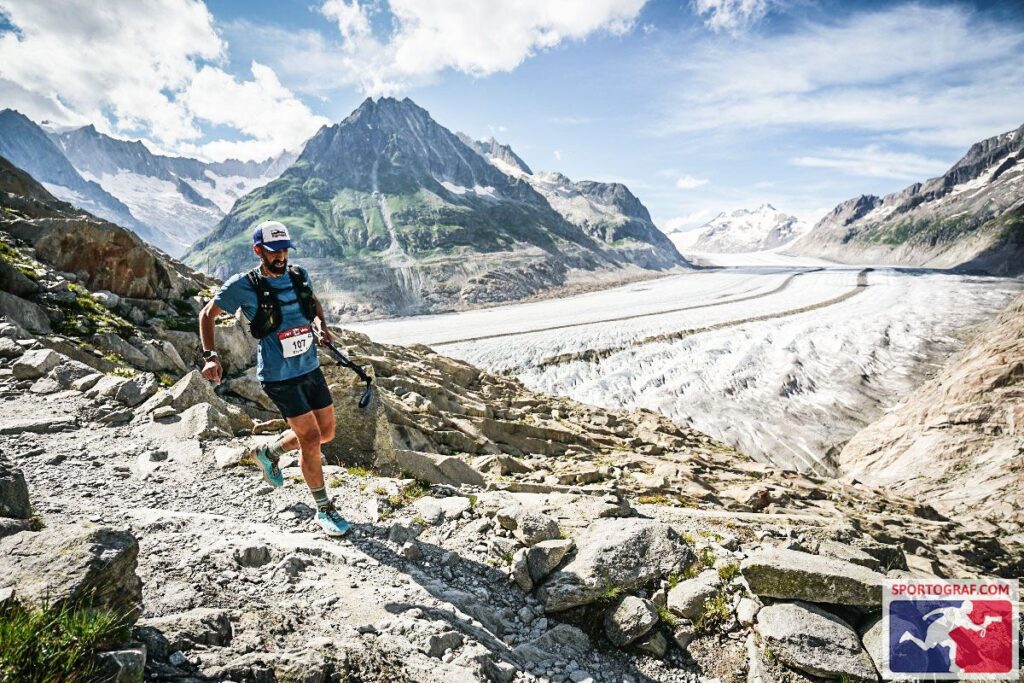
And so I did: from the start to kilometre 41 on the return to Riederfurka I ran well but without straining, with plenty of control on the two long descents and my knee was fine. Despite this, coming out of Riederfurka I felt exactly the same as in 2021: complete shit. And just like in 2021, I picked up and brought home a lot of walking until I entered the (fabulous) section that leads directly to the Aletsch. Towards the Glatscherstube I even recovered, but not enough to cope well with the horrible section of steps and stairs leading to the second suspension bridge. I suffered a lot, but the worst was yet to come. Between the bridge and the Bellwald aid station (km 62) I blew up, hot and with a pain in my right quadriceps that really had me worried. I took my time at the refreshment post, tried to cool down and drink since I was a bit ‘short’ of liquids and started walking again. Drama: my right quadriceps got stuck at the insertion point with my knee. It didn’t take me long to realise that in the three long descents I had gone into protection mode on the bad knee, which was now fine, but it was the other leg that was in pieces. Here I really lost hope because on the descent I couldn’t even limp. Running, no chance. I was holding on the climbs… but I wasn’t even halfway there.
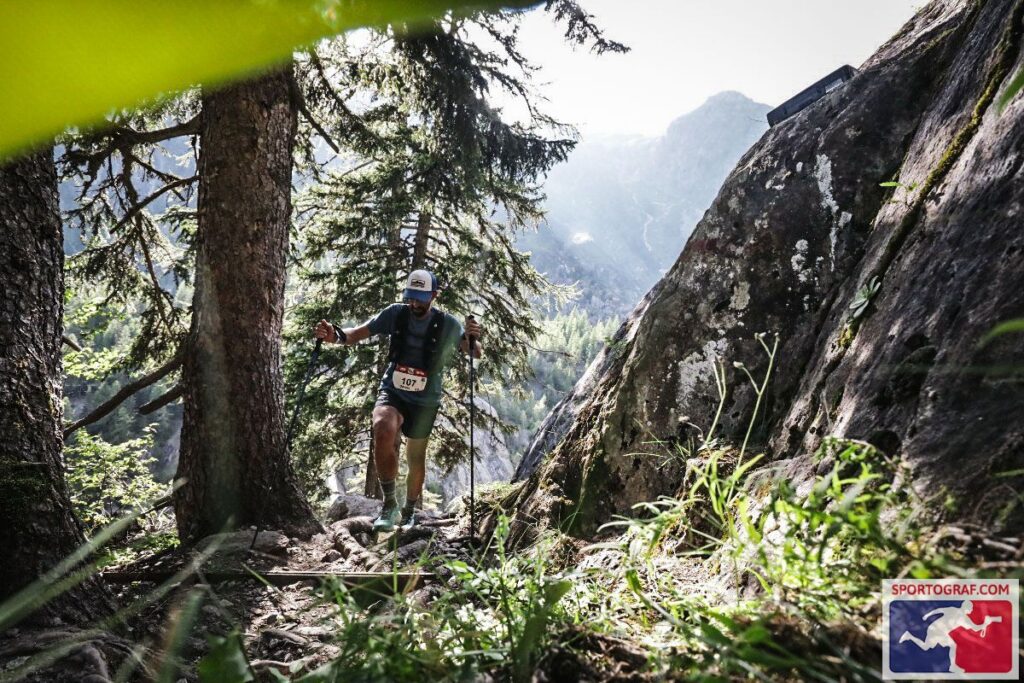
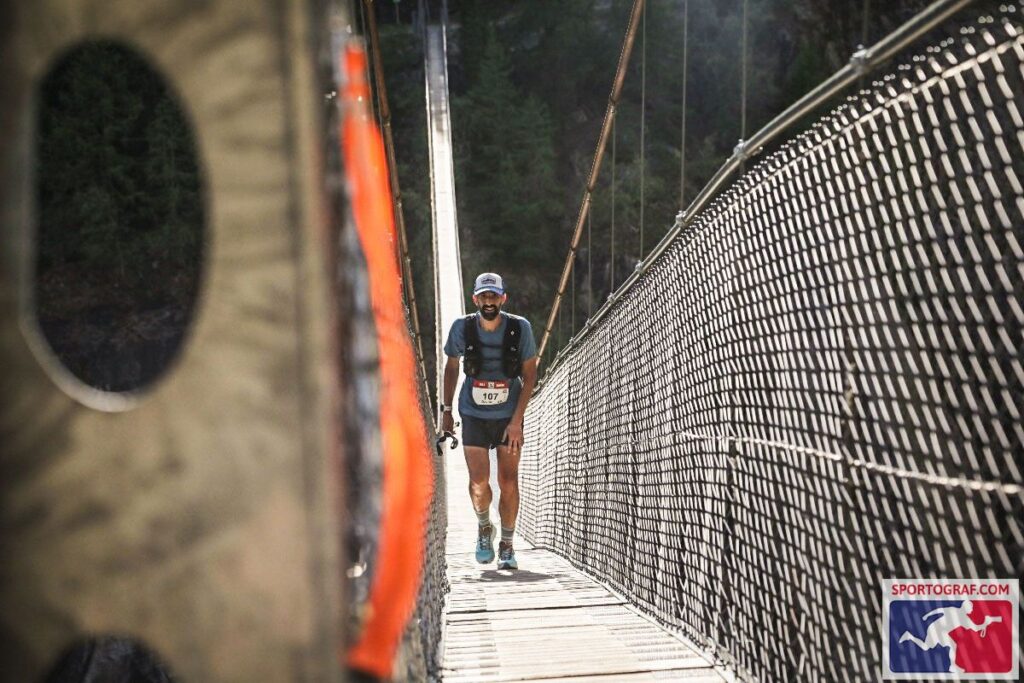
I finally got out of the funk thanks to a missed turn: I go straight to a fork in the road and do 400 metres uphill. I get pissed off, turn around, start running, and then laugh: in the end I’m still moving, what would be the point of stopping. I think that finally that bloody sun is going away, and in 4/5 kilometres there’s Ambro, my pacer, who will surely cheer me up.
Those four kilometres downhill I even manage to run, taking me to the aid station in Reckingen (km 74) with the desire to start again and try. Seeing Ricky and Ambro take care of me and cheer me up puts me in a good mood, and the next stretch is runnable: Ambro’s magic works and I start to run well again in the light of the headlamp. The long (new) climb to Binn goes quite smoothly, uphill we move well, even better than in 2021. The monstrous climb from Binn to Breithorn also goes well, including a three-minute microsleep halfway up under an exaggeratedly starry sky. The upper part we grind really well, catching up with a lot of people and moving efficiently. It’s a pity that the improvised descent after the landslides is a forgotten path (and there’s a reason for that) that drops 1200 metres in altitude in just a few kilometres. I descend slowly and don’t even bother because it really is a survival situation. The steep descent makes my feet hurt and the further down we go, the hotter it gets.
Refreshment point and final bag in Grengiols, absurd temperature, no ice, no cold drinks, but whatever, I am pumped up, I am still running well until the start of the infinite traverse next to the gully, where my light goes out a bit, it is really hot but I survive with the hope that at the last refreshment point there will be something to cool the system. But no, I get wet but I’m not feeling well. At the railway crossing we are forced to stop in the sun and there the drama: as soon as we start off again I feel sick, completely off and drained. Ambro teases me, but I’m really at the edge. Slowly I move forward, there’s a trickle of water coming down the wall and I get under it. I regain a minimum of dignity and on the way down to the village there is finally a fountain: I physically step into it, drink, and in two minutes I am reborn. I start talking again, reasoning and even enjoying myself, because in the end there are only 5 km to go. Ambro even wants me to pick up the cool English guy with whom I shared the last 20 km and who in my moment of apparent death passed me, but honestly I really couldn’t care less. I just want to do that last km again and finish.
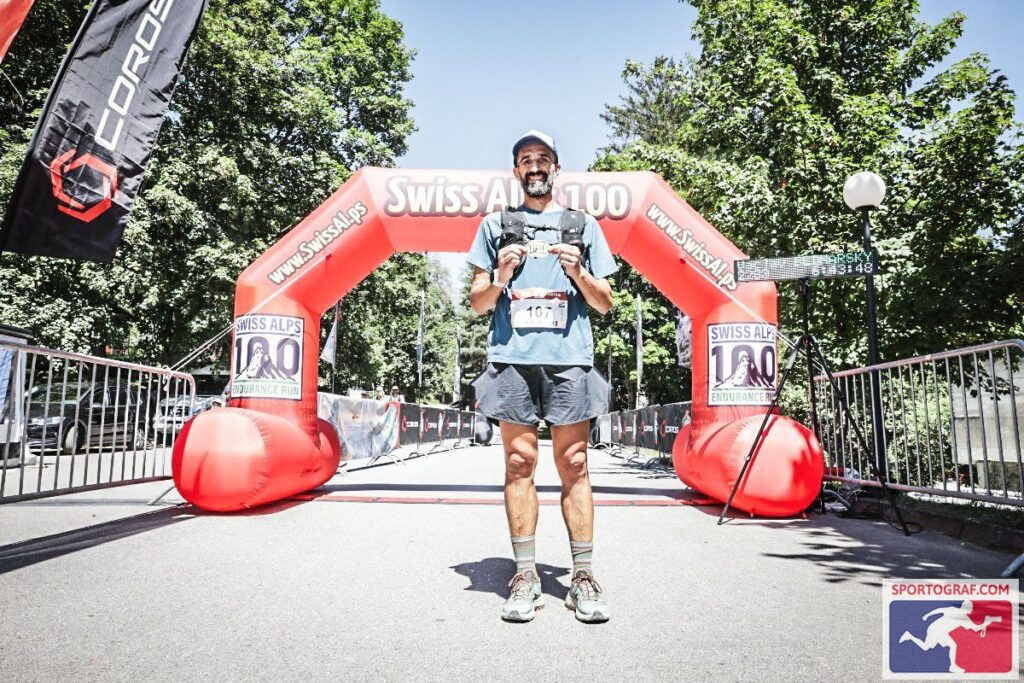
I sit down, Rino won, Giulia also, Fabio suffered, but as always he finished well. I eat a magnificent ‘pasta marinara’ served and revered by Ricky, we have a few words and then always the blessed pair Malacrida/Coriele take me back to the campsite. Shower, relax and pizza with the gang: I am so tired that I miss Ivan’s arrival for a minute, but by then I was really knocked out.
Tools for the future
If you haven’t raced for some time, you’d better put in a few practice races. I no longer had the ‘hand’ to manage certain aspects mentally and I lost lucidity when I passed the mark of the usual long run.
Any Endurance Camp with volume is a blessing. You can see it clearly on the graph and there is nothing that can replace that kind of stimulus. But it must be flanked, even in the last period, with quality work: targeted and specific, but it is an input that I (due to injury) skipped and that I really missed.
Fabio’s dad also says, ‘xe tutto una questiona de testa’ (it’s all a question of the head). If you know that yours only works so-so, rely on people who can support you at key moments: Ricky and especially Ambro, were great at getting me back on track when I needed it.
Nutrition is fine if you have a good plan and stuff that works. With our nutritionist Sara’s help, and Precision nutritionist Emily’s help plus Precision’s gels + salts, I went back to the good old days: 60 grams/hour for 30 hours and zero stomach problems. One gel every half hour. I screwed up on the electrolytes and didn’t drank enough, but it was a tricky balance and relying on the salts from the refreshment bar (which were still Precision, but mixed badly) soon sent me off track. To be worked on in the future, especially in training, because a certain intake of fluids has to be trained in the end.
Do age categories make sense in a 100-mile race? No. But at least I could tell Mum I had won. There’s no point Ambro being cheeky, my first senior trophy will end up in the office on display: in twenty years he’ll understand.
Did I find what I was looking for? Perhaps. Well, yes.
But each race closes one drawer and opens ten others, but these are drawers where I feel like digging through, the old one was stuff to be put away. I rolled up my sleeves and sorted them out.
Running is beautiful. If you win it’s nice, if you finish 10 it’s nice, if you finish 200 it’s still nice. If you are lucky enough to be well and be able to do it, it is a privilege that should not be let down. Be grateful, always.